If you're buying poly bags, poly tubing, or drum liners right now, pay attention. This stopped being a crude oil story weeks ago. It's a full-chain disruption, and resin markets are feeling it.
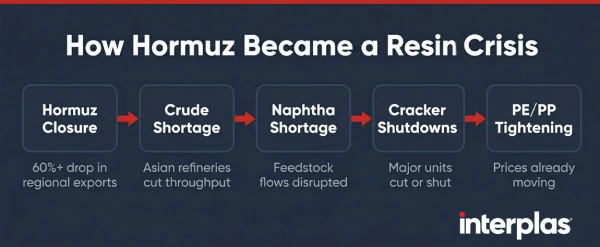
The Strait of Hormuz is effectively closed
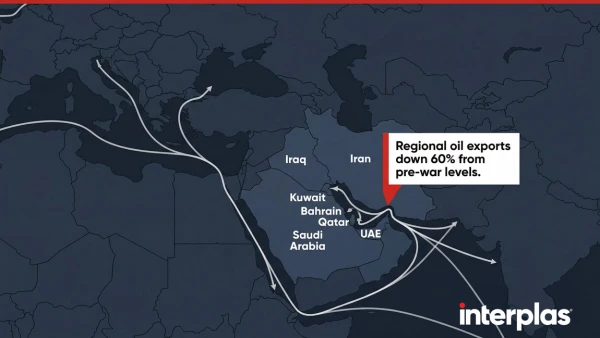
One-fifth of global oil and LNG moves through Hormuz. Since late February, that route has nearly shut down. Twelve-plus ships struck. War-risk insurance pulled.
- Regional oil exports are down 60% from pre-war levels.
- When crude, naphtha, LPG, and shipping all tighten together, the damage doesn't add up. It multiplies.
- The damage across the Middle East is confirmed and severe
- Qatar lost 17% of its LNG export capacity at Ras Laffan. Repair timelines: three to five years.
- Saudi Arabia cut output by 2 million bpd, suspended the 550,000-bpd Ras Tanura refinery, and took hits at SAMREF in Yanbu.
- Kuwait's Mina al-Ahmadi and Mina Abdullah refineries both caught fire after drone strikes. Force majeure declared.
- The UAE lost the Shah gas field, took hits at Habshan, and watched Fujairah, its main export route around Hormuz, get repeatedly attacked.
- Iraq's southern output dropped by 70%, from 3.3 million bpd to 900,000 bpd.
- Iran's South Pars was struck by Israeli attacks. It produces 70-75% of Iran's gas and feeds the entire Iranian petrochemical chain.
- Bahrain's Sitra refinery declared force majeure. Another naphtha source was knocked out.
- Asia is cutting runs and declaring force majeure
Naphtha can't move reliably. Crackers across the region are throttling back or shutting down entirely.
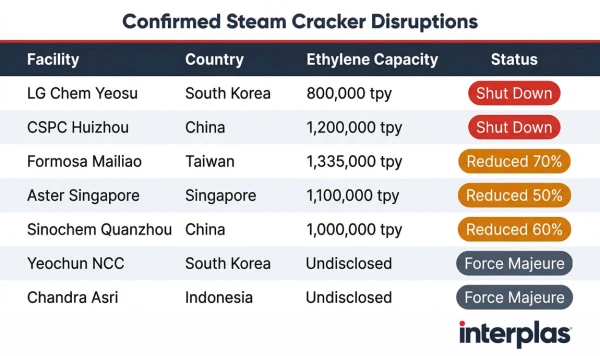
China: Sinochem's Quanzhou refinery and cracker both cut to 60%. Sinopec trimmed roughly 600,000-700,000 bpd. CNOOC/Shell Petrochemicals planned to shut a 1.2 million tpy cracker in Huizhou.
South Korea: LG Chem shut its 800,000 tpy Yeosu cracker. Yeochun NCC declared force majeure. The government restricted naphtha exports and classified it a supply-chain security item.
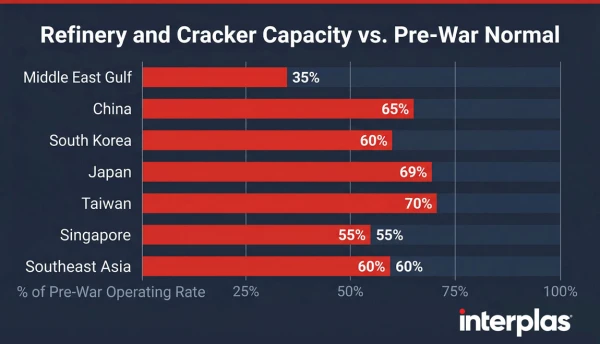
Japan: Refinery utilization dropped from 80% to 69%. Mitsui and Mitsubishi both cut ethylene production.
Taiwan: Formosa Petrochemical is running two Mailiao crackers at 70%, warning one could shut if naphtha doesn't arrive. Combined capacity: 1.3 million tpy of ethylene.
Singapore: Aster Chemicals declared force majeure on both ethylene and propylene, running its cracker at 50%. ExxonMobil's Jurong site cut crude runs from over 80% to around 50%.
Malaysia, Thailand, Indonesia, India, and Vietnam are all experiencing confirmed disruptions or government-level interventions.
What this means for PE and PP
For polyethylene, the cracker chain is where the pain is sharpest. Multiple major units are cut or shut. Ethylene supply is shrinking. Naphtha shortages are driving most of it.
For polypropylene, the mechanism is different, but the result is the same. Refinery throughput cuts are simultaneously squeezing propylene production across the Gulf and Asia. No single dramatic shutdown to point to, just broad, grinding pressure from every direction.
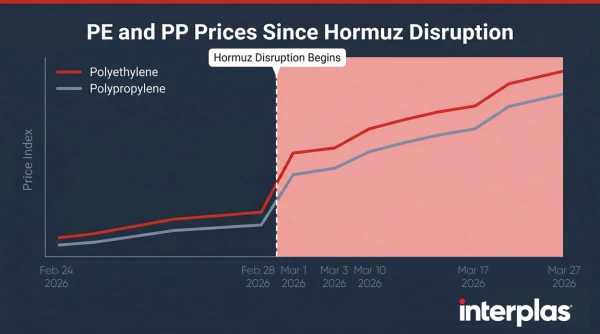
Prices have already moved. The longer Hormuz stays disrupted, the bigger the deficit grows. And the impact isn't linear.
What to watch
Several major sites are listed as threatened but not yet confirmed to be damaged, including Saudi Arabia's Jubail complex, Qatar's Mesaieed complex, and the UAE's Al Hosn gas field. If attacks reach those dedicated petrochemical hubs, this gets significantly worse.
Prices are already moving. If poly bags, drum liners, or poly tubing are part of your operation, now is the time to pressure-test your sourcing strategy. Talk to us before the next force majeure notice lands in your inbox. Contact interplas®.